How We Built BitcoinDerby: Integrating 5 Crypto Wallets Into One Unity WebGL Game
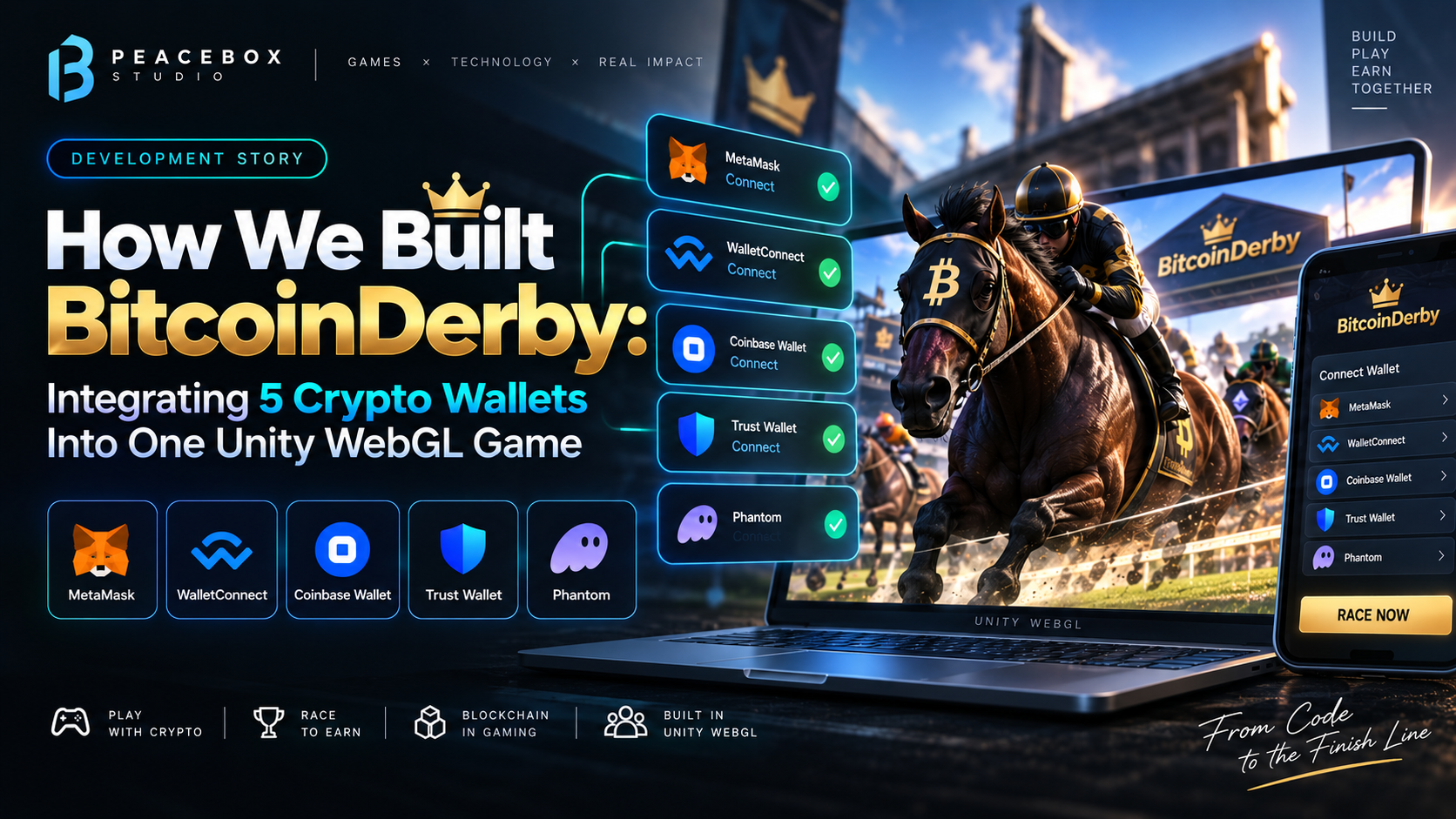
BitcoinDerby is one of the most technically complex projects we have ever shipped at Peacebox Studio — a live, real-money blockchain horse racing game running on Unity WebGL with 5 different crypto wallet integrations, 4,000+ NFT horses, and real-time multiplayer races with up to 100 spectators per race.
This post is a behind-the-scenes breakdown of how we pulled it off.
The Challenge
When the client approached us, the brief sounded simple: build a browser-based horse racing game where players race their Bitcoin Ordinals NFT horses and bet using gems. Simple enough.
Then came the requirements list.
Five different crypto wallets needed to work — each with their own SDK, authentication flow, and browser-based communication pattern. The game needed to support two different blockchains simultaneously (Bitcoin Ordinals and Ethereum). Real-time multiplayer had to support 100 simultaneous viewers per race. An in-game economy with gems, Stripe payments, and a quest system all had to function reliably in a WebGL environment.
And it all had to ship in under a year with a team of three.
Architecture: The Wallet Module Pattern
The biggest technical decision was how to handle 5 completely different wallet SDKs without duplicating core game logic.
We solved this by architecting each wallet as an independent, interchangeable authentication module. Every wallet — Magic Eden, Unisat, Leather, Xverse, and MetaMask — implements the same interface:
public interface IWalletProvider {
  Task<string> Connect();
  Task<string> GetAddress();
  Task<bool> SignMessage(string message);
  Task<TransactionResult> SendTransaction(TransactionData data);
}
This meant the game never needed to know which wallet was active. It just called the interface. Swapping wallets was a one-line change.
Multiplayer: Photon Fusion on AWS
For real-time races with 100 spectators, we needed a dedicated server architecture — not peer-to-peer. We chose Photon Fusion in Dedicated Server Mode, deployed as a headless Unity build on AWS EC2.
The key insight was separating spectators from participants. Only the 10 racing horses are full Photon NetworkObjects. Spectators receive a compressed broadcast of race state every 100ms via a custom Observer pattern — no unnecessary Photon events fired.
The Gem Economy
All in-game currency (gems) are managed server-side via a REST API, completely decoupled from the Unity client. Stripe webhooks validate every payment before gems are credited. This prevents any client-side manipulation of balances.
Lessons Learned
- Always build wallet integrations as interchangeable modules — not hard-coded integrations
- WebGL has strict memory limits. Object pooling is not optional, it is mandatory
- Decouple blockchain calls from gameplay with fire-and-forget + graceful fallback
- Test on the lowest-spec hardware your users might have, early and often
BitcoinDerby has been live for over 12 months with zero critical bugs in production. If you are building a Web3 game and want to talk architecture, reach out to us.
Developer at Peacebox Studio, building games, ERP systems, and mobile apps since 2016.
More Articles
Crowded Game Release Windows in 2026: What the Autumn Launch Rush Means for Indie Studios
October 2026 is packed with major game launches. Here’s what the crowded release calendar means for indie studios, and how to time your own launch for the best chance of being seen.
5 Common Mistakes in Game Development
Most game projects don’t fail because of bad ideas. They fail because of avoidable production mistakes. Here are five we see most often and how to avoid them.
UI/UX Design Trends in 2026: What Designers Need to Know
Discover the biggest UI/UX design trends in 2026, from AI-powered experiences and personalization to accessibility, microinteractions, responsive design, Figma, and modern design systems.